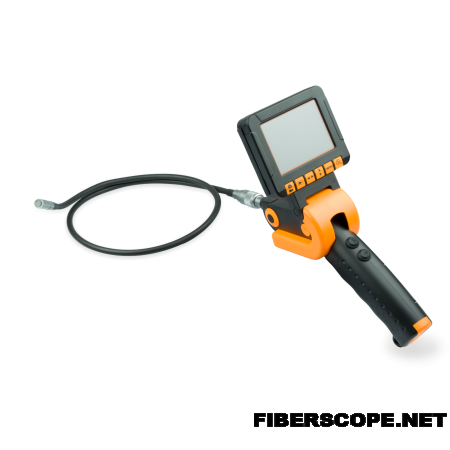
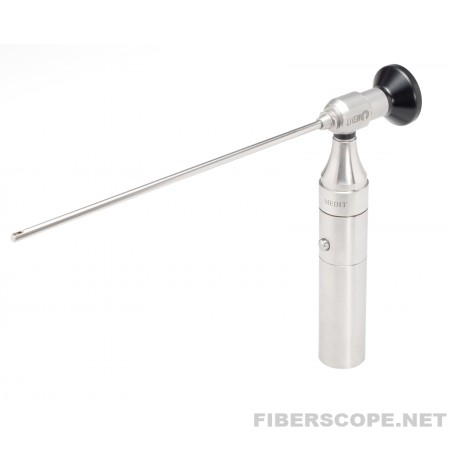
Rigid Borescopes and Fiberscopes for Bore Inspection
Hunters, target shooters, gunsmiths, collectors, firearms manufacturers and forensic examiners all need to see the inside of a barrel to judge its condition. We supply the borescopes and fiberscopes used for that work, and for the cleaning and maintenance decisions that follow from it.
We also carry out the inspection ourselves, at the customer's own site. One of our technicians brings the instrument to the workshop, the range or the factory, passes it through the barrel there, and reports what the surface shows.
A barrel is a long, narrow tube, and while it is in the firearm the only way to judge its condition is to look inside it. A bore inspection does exactly that. The instrument is introduced at the muzzle or from the chamber and is moved along the bore while the operator watches the surface pass.
All of this matters because of accuracy, and accuracy is where a barrel problem shows itself first. Groups grow larger, a rifle that used to shoot to one point starts shooting to another, or fouling builds up faster than it did before. Those are symptoms. Looking inside turns a symptom into a cause, and it tells you whether the answer is a thorough cleaning, a recrown, or a new barrel.
Calibre sets the diameter, and it sets it strictly. The instrument has to enter the bore without touching the rifling, so a small calibre needs a slender probe, and a slender probe has less room for illumination and for optics. Working length has to cover the barrel from end to end, a short reach for a handgun and a long one for a rifle. Magnification matters more here than in most inspection work, because the features being judged, a crack where the rifling begins or a shallow pit, are small enough that a general view will not settle the question.
We also carry out the inspection ourselves, at the customer's own site. One of our technicians brings the instrument to the workshop, the range or the factory, passes it through the barrel there, and reports what the surface shows.
A barrel is a long, narrow tube, and while it is in the firearm the only way to judge its condition is to look inside it. A bore inspection does exactly that. The instrument is introduced at the muzzle or from the chamber and is moved along the bore while the operator watches the surface pass.
What a bore inspection shows
Throat erosion is usually the first thing an experienced inspector looks for. Just ahead of the chamber, where the gas is hottest and the rifling begins, the surface develops a fine network of cracks and the sharp edges of the lands wear back. That area says more about how much life a barrel has left than any other part of it. Further along, the operator reads copper and carbon fouling, rust pitting, and the condition of the lands and grooves. At the far end the crown is checked for chips and for uneven wear, because the last surface the bullet touches has a large effect on where it goes.All of this matters because of accuracy, and accuracy is where a barrel problem shows itself first. Groups grow larger, a rifle that used to shoot to one point starts shooting to another, or fouling builds up faster than it did before. Those are symptoms. Looking inside turns a symptom into a cause, and it tells you whether the answer is a thorough cleaning, a recrown, or a new barrel.
Why the instrument is usually rigid
A bore is straight, so a rigid instrument suits it, and a rigid optical train carries a sharper image than a fibre bundle of the same diameter. The optical head normally looks sideways rather than forwards, through a prism set near the tip, because the target is the wall of the bore and not the far end of it. The operator rotates the instrument to sweep around the circumference and withdraws it slowly to cover the length. A flexible instrument is used where the inspection has to reach past the bore into the action or the gas system, and where there is not enough clear space behind the firearm to insert a rigid probe the full length of the barrel.Calibre sets the diameter, and it sets it strictly. The instrument has to enter the bore without touching the rifling, so a small calibre needs a slender probe, and a slender probe has less room for illumination and for optics. Working length has to cover the barrel from end to end, a short reach for a handgun and a long one for a rifle. Magnification matters more here than in most inspection work, because the features being judged, a crack where the rifling begins or a shallow pit, are small enough that a general view will not settle the question.